
Shopify Agentic Commerce: What AI Shopping Means for Your Store
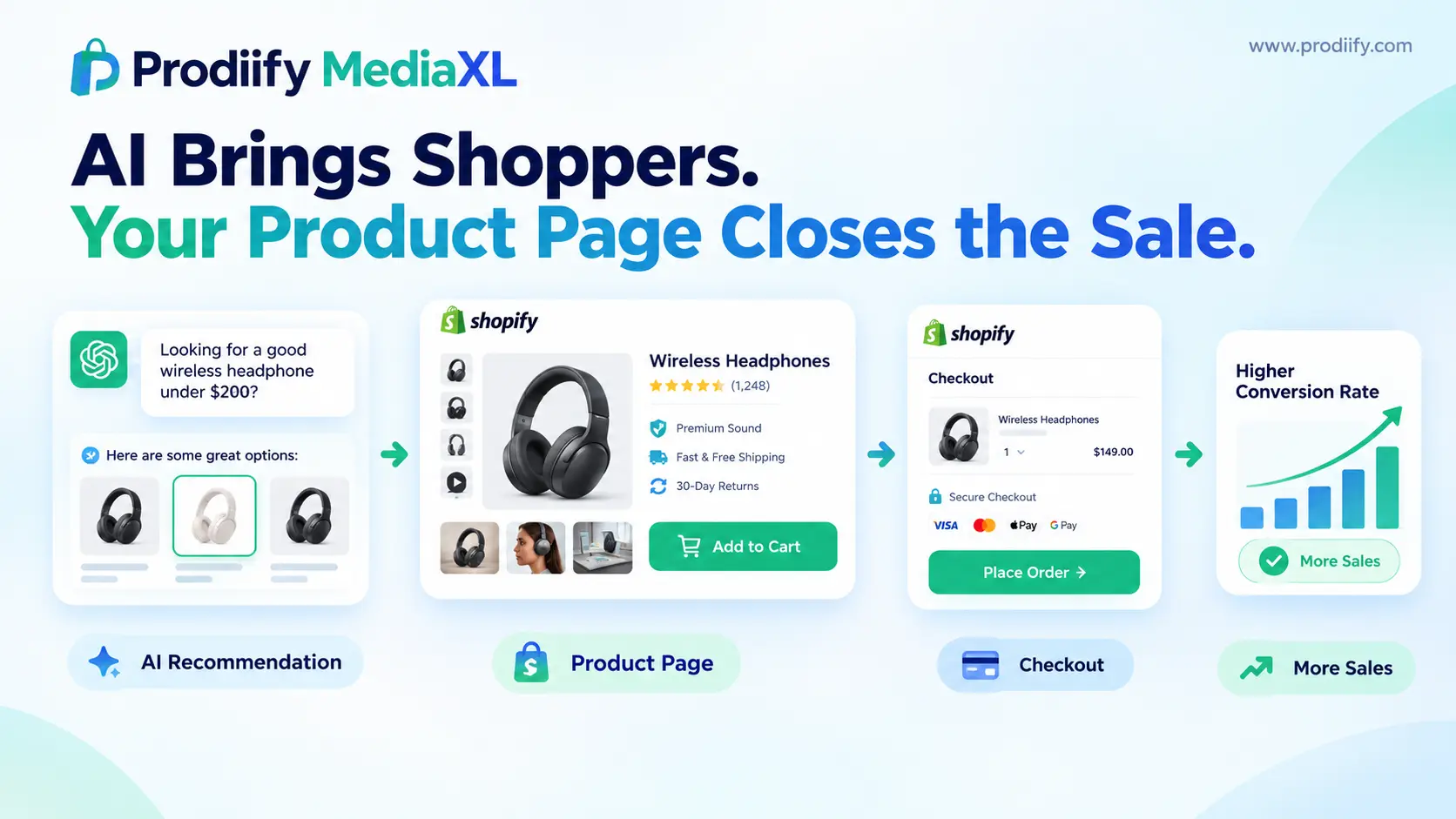
Shopify Agentic Commerce: The Merchant’s Guide to Selling Through AI Shopping
Shoppers are asking AI what to buy. Here is what is changing, the numbers behind it, and how to make sure your products are in the answer.
For years, an ecommerce sale followed one path: a shopper searched, clicked a result, browsed a store and checked out. That path is no longer the only one. Shoppers now describe what they need to an AI assistant and get a short list of products back, sometimes before they ever see a search results page.
How Shopify connects your products to AI assistants, what those assistants actually read, and how to audit your catalog before more shoppers arrive this way.
That is the core of Shopify agentic commerce: AI agents discovering, comparing and recommending products on a shopper’s behalf, with Shopify supplying the product data and checkout behind the scenes. The numbers show it is already material. Shopify told investors on its Q1 2026 call that AI-driven traffic to its stores grew 8x year over year, while orders from AI-powered searches rose nearly 13x.
From Search Box to Conversation: What Changed
In the traditional model, the path ran from Google to your website to checkout. With AI assistants, a shopper asks a question such as “a good waterproof jacket under $200”, and the assistant pulls matching products from a catalog rather than sending the shopper through ten tabs.
Two things follow from this:
- Your product data is now the storefront. The assistant often meets the shopper before your website does, so titles, descriptions, variants and prices are what get evaluated first.
- Gaps do not get filled in for you. One agency guide on Shopify’s setup notes that AI agents cannot fill gaps that a merchant leaves in the catalog. webplanex
How the System Works: Catalog, Storefronts and Protocols
Shopify’s approach has three connected parts.
Shopify Catalog
Shopify Catalog collects and organizes a store’s product information into a clean, structured format. It supplies product titles, descriptions, images, variants, pricing and availability in a format AI services can read. aitrillionwebplanex
Agentic Storefronts
Agentic Storefronts are the sales channel layer. They package a store’s catalog, checkout and brand details so AI platforms can present them naturally inside a chat. Eligible merchants can review their access under Sales channels > Agentic in the Shopify Admin. aitrillionwebplanex
Universal Commerce Protocol
Behind the scenes, a shared standard called the Universal Commerce Protocol (UCP) helps different AI platforms talk to merchant systems. One explainer puts the benefit simply: without UCP, merchants would need custom integrations for every AI platform. ringly
Which AI Platforms Are Involved
Coverage varies by platform, and it keeps changing, so treat this as a snapshot and confirm current status in your Shopify Admin.
| Platform | What reports say |
|---|---|
| ChatGPT | Described as the largest channel by reach, and made automatic for eligible US-selling merchants. Shoppers browse in ChatGPT and, according to one source, finish checkout on the merchant’s own store through an in-app browser or new tab. |
| Microsoft Copilot | Needs to be switched on manually in Shopify’s sales channel settings. |
| Google AI Mode and Gemini | Still in early access. www.aitrillion.com +3 |
One point worth knowing: because purchases can complete on your own checkout, your post-purchase upsells still fire, you keep the customer data, and checkout stays on your brand. That is a meaningful difference from selling through a marketplace. trueprofit
A caution from the same coverage: outside platforms apply their own ranking logic, so Catalog previews cannot guarantee an actual position. Nobody can promise you a recommendation. What you can control is whether your data gives the system a good reason to include you. webplanex
Why This Matters for Smaller Stores
A common worry is that AI will only recommend the biggest brands. Shopify’s own data suggests otherwise. In a podcast with Shopify’s VP of Product, roughly 70% of AI-attributed orders last year fell outside the top 100 product categories. AI matches products to the shopper’s stated need, so a well-described niche product has a real opening. transistor
Data quality also shows up in conversion. Shopify’s CFO said that traffic from catalog-powered AI searches converts about 2x better than traffic from general AI searches working from scraped or outdated information. You can read the coverage at Digital Commerce 360 and PYMNTS. digitalcommerce360
Your Readiness Audit for Shopify Agentic Commerce
Use this checklist on your top products first. Each row maps to something an AI assistant has to read or infer.
| What to check | Why it matters | What good looks like |
|---|---|---|
| Product title | The first signal of what the item is | Says what it is, who it is for and the key attribute |
| Description | Where the assistant finds use cases and differences | Benefits, use cases, materials, sizing and specs in clear sections |
| Variants | Shoppers ask for size, color and fit | Every variant named clearly, with no vague labels |
| Price and availability | Wrong data breaks trust fast | Accurate and current |
| Images | Confirm what the text claims | Several angles, with descriptive alt text |
| Policies | Shoppers ask about shipping and returns | Clear, easy to find and consistent |
| Metafields and attributes | Extra detail the catalog can use | Filled in where relevant, not left empty |
Then run a simple reality test, suggested in one merchant guide: open ChatGPT, search your own product category and see whether your store comes up. It is not a ranking tool, but it shows you how your category looks from the shopper’s side. trueprofit
What Merchants Should Do Next
You do not need a rebuild. Prioritize in this order.
1. Fix the content that machines and people both read. Replace thin copy with specific, structured information. Our guide to enhanced product descriptions on Shopify shows the format. To draft faster, use an AI product description generator for Shopify, a Shopify product description generator or these ChatGPT prompts for Shopify product descriptions.
2. Keep the SEO foundations solid. Clear titles, meta content and a technically healthy site help every channel. Work through our Shopify SEO checklist, these Shopify SEO tips and the Shopify technical SEO checklist.
3. Go deeper on AI-specific optimization. Our guides to Shopify AI search optimization for ChatGPT and how to get your Shopify products in ChatGPT cover that side in detail.
4. Make the landing page persuasive. Even when checkout happens on your store, the shopper still needs convincing. A strong hero message, scannable features and good visuals matter. See our guide to Shopify product page design. If you also sell on marketplaces, Shopify vs Amazon product pages shows where the gap usually appears. To understand the idea behind richer pages, read about A+ Content for Shopify or compare options in our Amazon A+ Content alternative for Shopify breakdown.
Doing the Work Across a Whole Catalog
An audit of five products is easy. An audit of five hundred is where stores stall, and where tooling pays off.
Prodiify is built for that. The AI SEO app for Shopify stores improves titles, descriptions and meta content in bulk, so more of your catalog is complete and consistent. Prodiify MediaXL then adds drag-and-drop blocks (Banner/Hero, Image + Text, Feature List, Gallery, Video and Carousel) to product pages, with no theme edits and no code.
A Four-Week Rollout Plan
- Week 1: Check your agentic channel settings in Shopify Admin and run the category test. List your top 20 products.
- Week 2: Rewrite titles and descriptions for the top 20, and fill in missing variant and attribute details.
- Week 3: Improve images, alt text and policy pages. Upgrade the product page layout for the top five.
- Week 4: Move to the next batch of products and compare performance on updated versus untouched listings.
Frequently Asked Questions
What is Shopify agentic commerce?
It is the system that lets AI assistants such as ChatGPT, Copilot and Gemini discover and recommend products from Shopify stores, using structured product data from Shopify Catalog, with Shopify handling checkout.
Do I need to install an app to appear in ChatGPT?
For eligible US-selling merchants, one guide reports the connection is automatic, with no app install needed. Eligibility and rollout can change, so check Sales channels in your Shopify Admin and Shopify’s Help Center for the current status.
Can I guarantee my products will be recommended?
No. Outside platforms apply their own ranking logic. You can improve your chances by making your catalog data complete, accurate and clear.
Will AI shopping send traffic to small stores?
It can. Shopify’s VP of Product said that a large share of AI-attributed orders came from outside the top 100 product categories, which points to opportunity for niche products.
Do I still need strong product pages?
Yes. Shoppers who arrive from an AI recommendation still need a page that confirms the choice and builds trust before they buy.
Conclusion: Shopify Agentic Commerce Rewards Complete, Accurate Catalogs
AI shopping is not replacing your store, but it is becoming another way shoppers find it. The merchants who benefit will be those with clear titles, complete descriptions, accurate data and pages that convince. Start with your best-sellers, audit one product at a time and keep improving.
Try Prodiify free on the Shopify App Store and get your listings ready for AI shopping.