
Shopify Product Title Optimization- 4 Tips to Rank Better
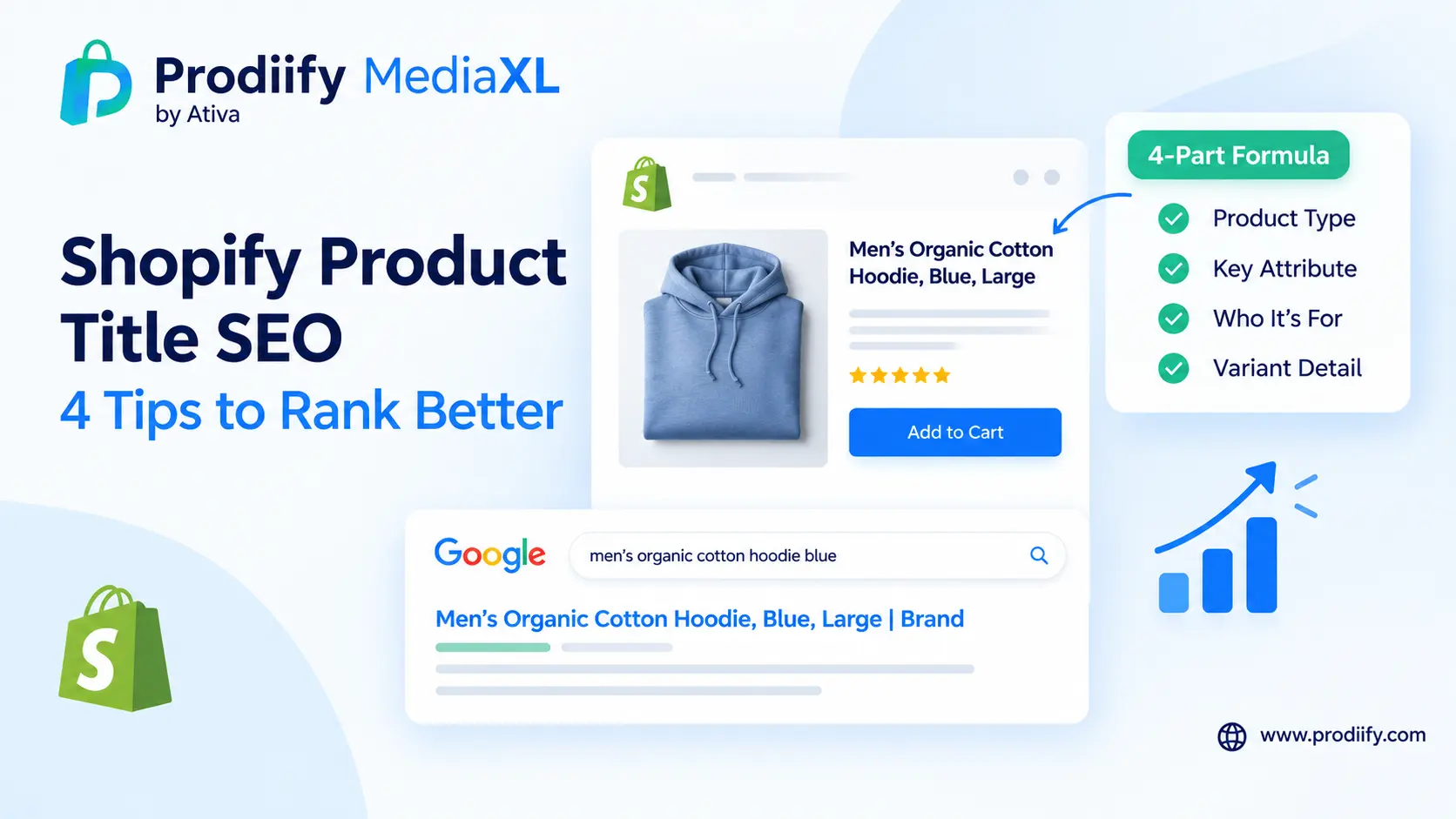
Shopify product title SEO comes down to clarity: tell shoppers and search engines exactly what you sell
Most Shopify product titles are written once, in a hurry, and never touched again: a supplier name, a SKU, or just “Classic Watch”. Yet the title shows up everywhere. It appears on your product page, in collection grids, in search results and in the product lists AI shopping tools read.
Getting your Shopify product title SEO right is one of the quickest improvements you can make, because it costs nothing and applies to every product. This guide gives you a formula, the length to aim for, the difference between your product title and your SEO title, and examples you can copy.
Why the Product Title Matters So Much
Shopify uses your product title in two places by default. According to one product listing guide, Shopify uses the product title as both the page H1 heading and the default meta title, and you can override the meta title in the SEO section of the product editor. ecosire
That makes the title the single most visible piece of text for each product. A vague title forces shoppers to guess and gives search engines and AI tools very little to work with. A clear one tells them what it is, who it is for and what makes it different.
The 4-Part Formula
Use this structure:
[Product type] + [Key attribute] + [Who or what it is for] + [Variant detail]
Brand name is optional. Add it at the end, or at the start if shoppers search for your brand by name.
| Part | What it does | Example |
|---|---|---|
| Product type | Says what it is | Leather Wallet |
| Key attribute | The defining feature | Slim, Handmade |
| Who or what for | Audience or use | for Travel |
| Variant detail | Size, color, material | Brown, RFID-Safe |
Result: Slim Handmade Leather Wallet for Travel, Brown
Several sources recommend putting the main product keyword first. A Shopify Community reply suggests a structure of primary keyword plus key differentiator plus brand name, such as “Waterproof Hiking Boots for Rough Terrain | Trailblazer.” An agency guide recommends a brand, type and attribute framework. The patterns differ slightly, but they agree on the core idea: be specific and lead with what the product is. shopifyvisionary-marketing
Before and After Examples
| Weak title | Better title | What changed |
|---|---|---|
| Classic Watch | Classic Leather Watch, Black, Water-Resistant | Adds material, color and a key feature |
| Hiking Boots | Waterproof Hiking Boots for Rough Terrain | Adds a feature and use case |
| Merino Socks | Merino Wool Hiking Socks, Cushioned, Unisex | Adds use, feature and audience |
| Candle 04 | Soy Wax Lavender Candle, 8 oz, Hand-Poured | Replaces a code with real details |
| Blue Tee | Organic Cotton Crew Neck T-Shirt, Blue, Men’s | Adds material, cut and audience |
| SKU-88217 | Stainless Steel Insulated Water Bottle, 500 ml | Replaces a SKU with what it is |
The first example mirrors advice shared in the Shopify Community, where one reply gives a weak title of “Classic Watch” and a better one of “Classic Leather Watch – Black, Water-Resistant, Unisex
How Long Should a Product Title Be?
There is no official magic number, and Shopify does not set one for titles. Community contributors give a few useful ranges:
- For product titles in general, one reply suggests 70 to 100 characters, balancing SEO value with readability and avoiding truncation.
- For the SEO title that appears in Google results, a community answer suggests around 50 to 60 characters, with the primary keyword or product name near the beginning.
Treat these as guides, not rules. The practical test: is it clear on a phone screen, and does it still make sense if it gets cut off?
Product Title vs SEO Title
Your product title and your SEO title can be different, and for many stores they should be.
- Product title: what shoppers see on the product page and in your store. It should read naturally and match your brand voice.
- SEO title (title tag): what appears as the headline in Google results. Edit it in the Search engine listing section at the bottom of the product page.
One guide explains the benefit: if your store display title needs to differ from your SEO title, which is common for variant-rich products, use the SEO title field in the search engine listing preview. Another notes that by default Shopify pulls the product title into the title tag, then appends the store name.
Leaving the field blank has a cost too. According to one community reply, if you leave it blank, Shopify falls back to the first lines of your body text, which usually reads flat. To avoid that, set your title tag on purpose.
Putting It Into Practice: 5 Steps
Good Shopify product title SEO is easier when you work through your store in this order.
1. Start with your top ten products. Pick the best sellers or highest-traffic pages first.
2. Rewrite each title with the formula. Put the product type first, then the key attribute, audience and variant detail.
3. Make every title unique. One community answer warns against using the same title across multiple products, because similar items then compete with each other in search.
4. Check the URL handle. Keep it short and readable. A community reply gives the example of merino-wool-socks rather than best-warm-merino-socks-2025. If you change a handle, use the redirect Shopify offers so the old link keeps its value.
5. Review on mobile. Open the page on your phone and check that the title reads well and does not run on.
Common Title Mistakes
- Keyword stuffing. A title like “Running Shoe Best Shoe Runner Shoe for Sale” is, as one SEO guide puts it, unappealing and can harm your rankings. Read our guide on keyword stuffing on Shopify for what to write instead.
- SKU or code only. Shoppers do not search for “SKU-88217”.
- Missing the product type. If the title never says what the product is, it is harder to match to a search. One agency states that if your title does not contain the product type, you will not show up for relevant queries.
- Duplicate titles across similar products.
- Separate titles for every color or size. One source notes that if you sell a t-shirt in 8 colors, you do not need 8 separate product titles, because Shopify generates variant URLs automatically.
- Too vague. “Classic Watch” or “Blue Tee” could be anything.
- Too long. Titles that sprawl get cut off in search results and on mobile.
Titles Work Best With the Rest of the Page
A clear title is the start, not the whole job. It works best alongside strong descriptions, images and layout.
- Write descriptions that answer shopper questions. Our guide to enhanced product descriptions on Shopify shows the format. To draft faster, use an AI product description generator for Shopify, a Shopify product description generator or these ChatGPT prompts for Shopify product descriptions.
- Describe your images properly. See our guide to Shopify image alt text.
- Cover the basics in our Shopify SEO checklist, these Shopify SEO tips and the Shopify technical SEO checklist.
- Make the page convince. See our guide to Shopify product page design. If you sell on marketplaces too, Shopify vs Amazon product pages shows where the gap tends to appear. To understand richer pages, read about A+ Content for Shopify or compare options in our Amazon A+ Content alternative for Shopify breakdown.
- Prepare for AI shopping. Clear titles help AI tools understand what you sell. Read our guides to Shopify AI search optimization for ChatGPT, how to get your Shopify products in ChatGPT, how to check if ChatGPT recommends your products and Shopify agentic commerce.
Get Help Writing Titles, Product by Product
Writing a clear title for every product takes thought, especially when you have a lot of them. Prodiify helps here. The AI SEO app for Shopify stores helps you write and refine titles, descriptions and other product content one product at a time, so you start from a draft rather than a blank box. For the visual side of your page, Prodiify MediaXL adds drag-and-drop blocks (Banner/Hero, Image + Text, Feature List, Gallery, Video and Carousel) to product pages, with no theme edits and no code.
FAQs About Shopify product title SEO
1.What makes a good Shopify product title for SEO?
A clear structure: product type, key attribute, who or what it is for, and a variant detail such as color or size. Lead with what the product is, and add your brand name at the end if it helps.
2.How long should a Shopify product title be?
There is no official limit. Community advice suggests roughly 70 to 100 characters for the product title and about 50 to 60 characters for the SEO title that appears in Google results. Prioritize clarity over hitting a number.
3.Does changing a product title hurt SEO?
The title itself can be edited safely, and the page URL only changes if you edit the handle. If you do change a handle, use the redirect Shopify offers so the old link keeps its value.
4.What is the difference between a product title and a title tag?
The product title is the headline on your product page. The title tag, or SEO title, is what appears in Google results. By default Shopify uses the product title for both, but you can set a separate SEO title in the Search engine listing section.
5.Can I A/B test product titles in Shopify?
Shopify does not have native title testing, so changes are usually compared before and after, or tested with a third-party tool. Change one thing at a time and track results over several weeks.
6.Should I put keywords in my product title?
Yes, but naturally. Use the words shoppers actually use to describe the product. Do not repeat the same term several times.
Conclusion: Better Shopify Product Title SEO Starts With Clarity
You do not need to rebuild your store to improve it. Clear Shopify product title SEO helps shoppers, search engines and AI tools understand what you sell, and it takes minutes per product. Start with your top ten products, apply the formula, and move on to the rest as you go.